
West Bengal Chief Minister Suvendu Adhikari asserted that his government would adopt a 'zero tolerance' policy against vandalism carried out under the guise of religious slogans.

India remains one of the Hyundai Motor group's most important and strategic markets globally. The initiative positions India as a strategic core market for the group's growth, emerging market expansion, and next-generation automotive innovation.

Premature surrender and withdrawal of life insurance policies in India have surpassed maturity payouts over the past five years, indicating a growing trend of policyholders exiting long-term policies before their full tenure, according to data presented in the Lok Sabha.

India's wholesale price-based inflation surged to 11.39 per cent in September, up from 9.92 per cent in August, primarily driven by increasing prices of food, manufactured items, and fuel and power.

A think tank, GTRI, has urged India to resist US pressure regarding its UPI policies, advocating for competition, policy autonomy, and a sustainable payments ecosystem. This comes as the Lok Sabha passed a bill allowing charges on UPI, and the US has criticised India's digital payment systems, raising concerns about the future of India's digital payment landscape.
A think tank, GTRI, has urged India to resist US pressure regarding its UPI policies, advocating for the defence of competition, policy autonomy, and the long-term sustainability of its payments ecosystem. This comes as the Lok Sabha passed a bill allowing charges on UPI transactions, a move GTRI suggests should not be influenced by foreign trade complaints.

Punjab Chief Minister Bhagwant Mann has confirmed Pakistan's participation in the upcoming Men's Asian Champions Trophy hockey tournament in India. The event, scheduled from October 27 to November 5 in Jalandhar and Mohali, will feature six nations, with India hosting its arch-rivals under the central government's policy allowing multi-lateral sports engagements.

A member of the National Traders' Welfare Board (NTWB) has urged the central government to withdraw its decision to impose a 0.4 per cent Merchant Discount Rate (MDR) on UPI transactions exceeding Rs 2,000, effective from October 15. He warned that the new charge, which will be borne by merchants, could negatively impact business growth and lead to higher prices, contradicting the government's 'ease of doing business' policy.

The CBI has issued fresh summons to Rajbir Ghuman, OSD to Punjab Chief Minister Bhagwant Mann, in an alleged corruption case involving pecuniary benefits for managing postings of IAS and IPS officers. Ghuman failed to appear for questioning on Friday, leading CBI teams to paste summons on his premises. The case, registered on Tuesday following Punjab and Haryana High Court orders, also led to raids at eight locations.

Uttar Pradesh Chief Minister Yogi Adityanath announced the state's ambitious shift from mobile phone assembly to advanced microchip manufacturing, data centres, and artificial intelligence. He highlighted significant investments and growth in the digital economy, attributing the transformation to the "double-engine government's" alignment with national initiatives like 'Make in India' and 'Aatmanirbhar Bharat'. Adityanath also criticised previous administrations for hindering the state's potential.

India's exports saw a significant 23 per cent increase, reaching USD 44.4 billion in September, while the trade deficit narrowed to USD 30.21 billion, according to recent government data.
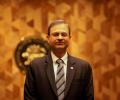
The Reserve Bank of India's Monetary Policy Committee (MPC) has commenced its three-day meeting, with a majority of economists and bankers anticipating a 25 basis point rate hike to counter escalating inflation risks, particularly from West Asia conflicts.

The Supreme Court has urged the CBSE to reconsider the implementation of its three-language policy for Class 9 students, emphasising that children should not be subjected to undue pressure. The court highlighted concerns about infrastructure, the starting point of the policy, and the definition of 'native' languages.


A CII white paper released Thursday outlines a strategy for India's media and entertainment sector to achieve a USD 100 billion valuation by the early 2030s, requiring an annual growth rate of 15 per cent and significant policy reforms. The paper identifies key areas for growth, including broadcasting reform, anti-piracy measures, and investment in regional markets.

The Kerala Legislative Assembly has passed a motion urging the central government to completely withdraw the proposed Merchant Discount Rate (MDR) on UPI transactions exceeding Rs 2,000. Chief Minister V D Satheesan and CPI MLA K Rajan highlighted concerns that the MDR would increase business costs, harm small businesses, and reduce the appeal of digital payments, while the BJP argued it would not affect general public or small merchants.

Union Minister Ashwini Vaishnaw announced that the Indian government will release a draft consultation paper on Artificial Intelligence (AI) regulations within the next 30 days, focusing on safety, a human-first approach, skilling, inclusivity, and harm restriction.

Experts at a national symposium in Shillong discussed the role of Artificial Intelligence in tourism, emphasising that AI should support human judgment, local knowledge, and cultural values rather than replace them. Discussions highlighted the need for robust policies to address ethical concerns, safeguard livelihoods, and preserve cultural heritage while leveraging AI for innovation and sustainability in the tourism sector, particularly in Meghalaya.

'Nearly two-thirds of Maharashtra has been drought-prone on and off, and climate change is making it worse.'

Congress leader Rahul Gandhi launched a scathing attack on the BJP-RSS, labelling them a "bunch of jokers" with no understanding of India, and criticised Prime Minister Narendra Modi's foreign policy as merely "hugging leaders." He also claimed the RSS has become an instrument of large capital, serving Adani and Ambani, and vowed that the Congress would keep pressure on the government until Modi and Shah resign. The BJP hit back, calling Gandhi immature and out of depth.

"Pressure on the current account is a temporary problem. Sooner rather than later, our external sector will improve," said RBI Governor Sanjay Malhotra.

There is no answer to the question of how IN-SPACe invited EOIs for ISRO's mature rockets and whether it was based on any government policy decision.

TCS chief executive and managing director K Krithivasan stated that the US is unlikely to target tech companies based on their domicile, with actions like the recent green card application programme suspension being driven by local sensitivities around jobs.

India is deeply concerned by the growing consolidation of Pakistan-backed jihadi and radical Islamist groups in Bangladesh, particularly in the strategically vital Chittagong Hill Tracts, which experts warn is transforming the country into a new safe haven for these networks and posing a direct threat to India's security.

The Indian government has approved the sale of a 60.72 per cent stake in IDBI Bank Ltd to Canadian billionaire Prem Watsa's Fairfax Financial Holdings Ltd for approximately 52,878 crore, a move that reflects improving India-Canada ties and marks a significant turning point for the bank.

HCLTech has announced a global partnership with Anthropic to establish a dedicated business unit focused on developing agentic AI solutions for enterprise clients using Anthropic's Claude. The collaboration aims to help businesses adopt AI systems that operate with minimal human intervention, prioritising safety, cybersecurity, and governance. HCLSoftware will also integrate Claude into its enterprise products.

The BJP has narrowly defeated the Congress in the Rajasthan urban local body elections by less than one percentage point. Independent candidates secured a significant share of votes, and NOTA outperformed several smaller parties. Prime Minister Modi lauded the BJP's performance, attributing it to public support for good governance.

Dedicated Ayush dispensaries increased from 26,130 in 2013-2014 to 37,804 in 2024-2025, while hospitals rose much more slowly, from 3,605 to 3,885.

The owner of a medical store, Ashwani Kumar, accused of fatally shooting anti-drug activist Parvinder Singh Jhota in Punjab's Mansa, has been arrested from Rajasthan. Following his arrest, angry mobs set his medical store ablaze and authorities razed a portion of his house, while Jhota's father has called for a statewide bandh on October 15.

Pakistan is set to participate in the Men's Asian Champions Trophy hockey tournament in India, with Punjab Chief Minister Bhagwant Mann confirming the union government's policy allows multi-lateral engagements despite bilateral tensions. The tournament, featuring six nations including India and Pakistan, will be held from October 27 to November 5 in Jalandhar and Mohali, with free entry for all matches.

The scenes are same; placards, viral videos, riot, police but the grievances could hardly be more different, notes Abhay Jere, ex-Vice Chairman, AICTE.

Suzuki Motor Corporation is set to revolutionise its operations by halving vehicle development times and significantly boosting efficiency by 2030, while committing to a diverse multi-powertrain strategy that includes BEVs, hybrids, and carbon-neutral fuels.

Prime Minister Narendra Modi lauded India's 7.8 per cent GDP growth, achieved despite global conflicts and instability. He emphasised the importance of Swadeshi and self-reliance for a developed India by its 100th year of Independence, urging citizens to avoid unnecessary foreign expenditures.

A rocket designed and developed by ISRO is being transferred to industry for production.
Nine ISRO associations want to know whether this is simply an effort to expand India's industrial capacity or part of a larger policy under which ISRO itself will eventually withdraw from rocket manufacturing.

India has secured a spot among the top 10 leading emerging-market performers in artificial intelligence (AI) readiness, with private investment in AI more than tripling to USD 4.1 billion in 2025, according to a new World Bank report.
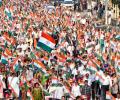
The Union Home Ministry's High-Level Committee on Demographic Changes has requested states and Union Territories to provide detailed data on "visible changes" in religious demography over the last 15 years. This includes information on birth registrations, religious structures, vehicle registrations, property transfers in tribal areas, and educational institutions, aiming to assess demographic shifts and recommend policy measures.

The Delhi Police informed the High Court that Jantar Mantar was denotified as a protest site based on Supreme Court directions, a revelation made during a hearing on a plea by the Indian Youth Congress seeking protest permission. The court issued notice on the IYC's request for reconsideration and broader issues concerning protest regulation, while new sites have been designated.

Indian benchmark stock indices, Sensex and Nifty, closed lower due to profit-taking, a spike in wholesale price-based inflation, and firm crude oil prices, despite some support from easing intraday crude oil prices and rupee appreciation.

India's GST Council has approved changes allowing small online sellers to register in states without physical premises by using an e-commerce operator's warehouse as their principal place of business, aiming to boost national sales for small businesses.

The RSS-affiliated Bharatiya Kisan Sangh (BKS) is set to host its inaugural women's conclave in New Delhi, aiming to advocate for increased representation of women farmers in agricultural policymaking. The event will bring together 7,000 women farmers to discuss their significant contributions to farming, livestock, and fisheries, and to push for policy changes, including a shift from MSP to MRP for produce.
